

- Use Cases
- Automated Testing Workflow Automation
- Pricing View
- Subscription
- Ideal For
- Developers Enterprises
Overview
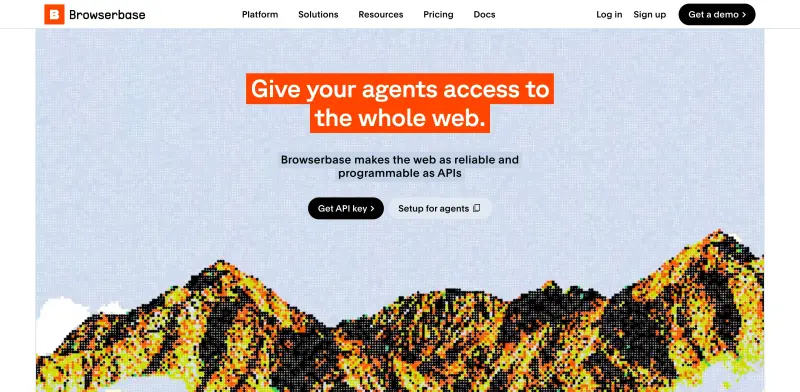
Browserbase is a tool that gives agents access to the entire web, making it as reliable and programmable as APIs. It helps companies and developers build beyond the limitations of traditional APIs, enabling them to automate tasks and interact with the web in a more human-like way.
By providing a bridge between AI and the digital world, Browserbase allows agents to perform tasks that would normally require human intervention, such as logging in to websites, navigating complex interfaces, and extracting data. This enables businesses to automate tedious tasks, accelerate ambitious projects, and gain insights from the vast amount of data available on the web.
Details
Key Features
- Search API: allows agents to quickly find relevant websites based on a single query
- Fetch API: enables agents to fetch web context by converting any URL into HTML, JSON, or markdown
- Browser-as-a-Service: provides agents with a real browser to use the web like a human, navigating interactive websites and performing complex actions without interruptions
- Zero setup and real results: allows developers to spin up a browser, connect their model, and execute their first task with minimal setup
Best For
- Developers and companies building automated workflows and agents that interact with the web
- Businesses looking to automate tedious tasks and gain insights from web data
- Researchers and data scientists who need to extract data from the web at scale
Top Use Cases
- Automating data extraction and web scraping tasks
- Building agents that can interact with websites and perform complex actions
- Researching and monitoring web trends and data
Integrations
- Browserbase provides a range of APIs and tools, including the Search API, Fetch API, and Browser-as-a-Service, that can be integrated with other platforms and tools
Pros
- reliable and programmable web interaction
- access to the entire web
- zero setup and real results
- scalable and flexible
Read full editorial notes
What is Browserbase?
Browserbase is a platform that allows agents to interact with the web in a reliable and programmable way, using the browser as a native interface. It provides a range of tools and APIs that enable developers to build agents that can perform tasks on the web, from simple data extraction to complex interactions.
What are the key features of Browserbase?
Search API: allows agents to quickly find relevant websites based on a single query
Fetch API: enables agents to fetch web context by converting any URL into HTML, JSON, or markdown
Browser-as-a-Service: provides agents with a real browser to use the web like a human, navigating interactive websites and performing complex actions without interruptions
Zero setup and real results: allows developers to spin up a browser, connect their model, and execute their first task with minimal setup
100% of the web at production scale: enables agents to access the entire web, including websites that are not accessible through traditional APIs
Who is Browserbase best for?
Developers and companies building automated workflows and agents that interact with the web
Businesses looking to automate tedious tasks and gain insights from web data
Researchers and data scientists who need to extract data from the web at scale
What can you use Browserbase for?
Automating data extraction and web scraping tasks
Building agents that can interact with websites and perform complex actions
Researching and monitoring web trends and data
How does Browserbase compare to alternatives?
Unlike traditional APIs, Browserbase provides access to the entire web, including websites that are not accessible through APIs
Compared to other browser automation tools, Browserbase provides a more reliable and programmable way to interact with the web, with features like zero setup and real results
What integrations and ecosystem support does Browserbase offer?
Browserbase provides a range of APIs and tools, including the Search API, Fetch API, and Browser-as-a-Service, that can be integrated with other platforms and tools
What are the pros of Browserbase?
Pros: reliable and programmable web interaction; access to the entire web; zero setup and real results; scalable and flexible
Keep researching Browserbase
Explore relevant products with a similar category, audience, or use case.



Resources
Social Profiles
Useful Links
Launched
Ownership
If this is your product, contact us and we can help transfer it to you.
 ChatGPT,
 Claude,
 Perplexity,
 Gemini