
- Pricing View
- Subscription
- Ideal For
- Developers DevOps Teams
Overview
Docker is a platform that helps developers build, share, and run container applications, handling tedious setup so they can focus on coding.
Docker simplifies the process of creating and deploying applications by providing a consistent and reliable way to package, ship, and run containers. This allows developers to work more efficiently and effectively, without worrying about the underlying infrastructure.
Details
Key Features
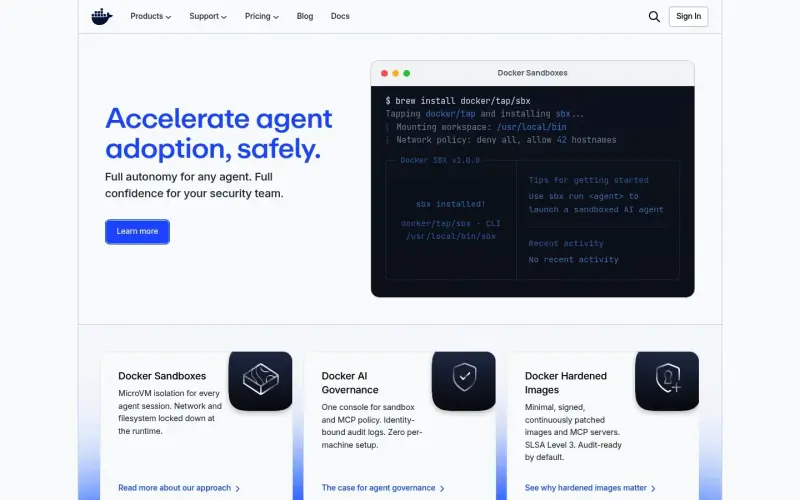
- MicroVM isolation for every agent session, providing a secure and reliable environment for application development and deployment
- Network and filesystem lockdown at runtime, ensuring that applications are secure and cannot access sensitive data
- One console for sandbox and MCP policy, making it easy to manage and monitor applications
- Identity-bound audit logs, providing a clear and transparent record of all application activity
Best For
- Developers who want to build, share, and run container applications
- DevOps teams who need to deploy and manage applications in a secure and reliable way
- Organizations that want to improve the efficiency and effectiveness of their software development and deployment processes
Top Use Cases
- Building and deploying web applications
- Creating and managing microservices
- Developing and testing software in a secure and isolated environment
Integrations
- Docker provides integrations with a wide range of tools and platforms, including Docker Desktop and Docker Sandboxes
Pros
- secure and reliable
- efficient and effective
- easy to use and manage
Limitations
- may require significant resources and expertise to set up and manage
- can be complex to use for large-scale deployments
Read full editorial notes
What is Docker?
Docker is a platform that helps developers build, share, and run containerized applications, making it easier to create and deploy software. It handles the tedious setup, allowing developers to focus on writing code and building applications.
What are the key features of Docker?
MicroVM isolation for every agent session, providing a secure and reliable environment for application development and deployment
Network and filesystem lockdown at runtime, ensuring that applications are secure and cannot access sensitive data
One console for sandbox and MCP policy, making it easy to manage and monitor applications
Identity-bound audit logs, providing a clear and transparent record of all application activity
Zero per-machine setup, making it easy to get started with Docker and deploy applications quickly
Who is Docker best for?
Developers who want to build, share, and run container applications
DevOps teams who need to deploy and manage applications in a secure and reliable way
Organizations that want to improve the efficiency and effectiveness of their software development and deployment processes
What can you use Docker for?
Building and deploying web applications
Creating and managing microservices
Developing and testing software in a secure and isolated environment
How does Docker compare to alternatives?
Docker provides a more secure and reliable way to deploy and manage applications compared to traditional virtualization technologies
Docker offers a more efficient and effective way to build and deploy applications compared to manual deployment methods
What integrations and ecosystem support does Docker offer?
Docker provides integrations with a wide range of tools and platforms, including Docker Desktop and Docker Sandboxes
What are the pros and limitations of Docker?
Pros: secure and reliable; efficient and effective; easy to use and manage
Limitations: may require significant resources and expertise to set up and manage; can be complex to use for large-scale deployments
Keep researching Docker
Explore relevant products with a similar category, audience, or use case.



Resources
Social Profiles
Launched
Ownership
If this is your product, contact us and we can help transfer it to you.
 ChatGPT,
 Claude,
 Perplexity,
 Gemini