


OpenObserve: Open Source Observability Platform
Scale your observability with a fast, cost-effective platform designed for AI-era performance and efficiency.
167 website clicks
Launch week 17, 2026
- Use Cases
- Not listed yet
- Pricing View
- Subscription
- Platforms
- Not listed yet
- Ideal For
- DevOps Teams SaaS Founders
Overview
Unlock Efficient Observability with OpenObserve: 140x Lower Storage Costs and Petabyte-Scale Performance
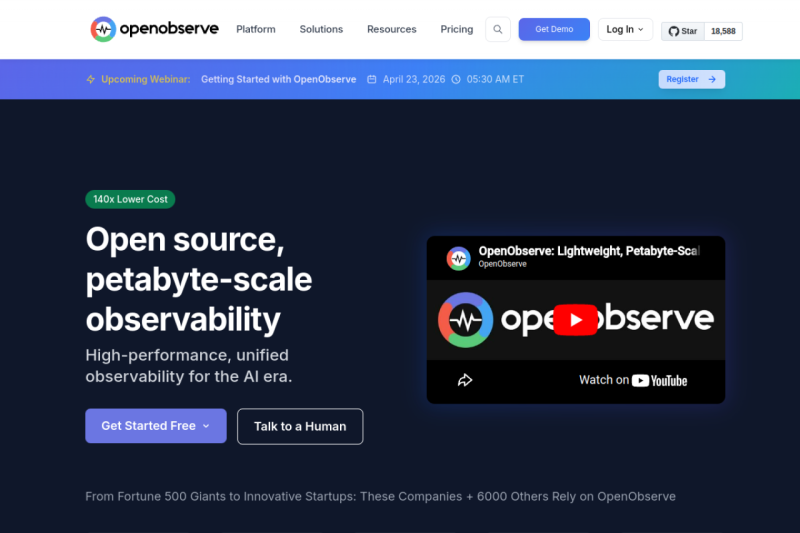
OpenObserve solves the main pain point of costly and inefficient observability platforms by providing a fast, scalable, and cost-effective open source solution that allows users to monitor logs, metrics, and traces with significantly lower storage costs, making it an ideal choice for businesses looking to optimize their observability infrastructure.
Details
Key Features
- Drastically reduce infrastructure costs with 140x lower storage costs compared to Elasticsearch, resulting in significant savings for businesses.
- High-performance, unified observability for the AI era, allowing for real-time monitoring and analysis of logs, metrics, and traces.
- Open source and open standards ensure compatibility and interoperability with existing tools and workflows, providing users with the freedom to customize and extend the platform.
- High compression and columnar storage with Apache Parquet enable efficient data storage and retrieval, making it ideal for large-scale observability needs.
- Stateless architecture and horizontal scaling allow for seamless growth and high performance, even at scale, ensuring that the platform can handle increasing demands without compromising performance.
Ideal For
- Founders and DevOps teams of startups and scale-ups looking for a cost-effective and efficient observability solution to monitor their applications and infrastructure.
- Enterprise IT teams seeking to optimize their observability infrastructure and reduce costs while maintaining high performance and scalability.
- AI and machine learning teams requiring real-time monitoring and analysis of large datasets to improve model performance and decision-making.
Top Use Cases
- Monitoring and analyzing application performance and logs to identify bottlenecks and areas for optimization, resulting in improved user experience and reduced downtime.
- Real-time monitoring of metrics and traces to detect anomalies and security threats, enabling proactive measures to prevent incidents and minimize their impact.
- Optimizing infrastructure costs and resource utilization through efficient data storage and retrieval, leading to significant cost savings and improved resource allocation.
Known Alternatives
- A cost-effective and open source alternative to Elasticsearch, offering 140x lower storage costs and improved performance, making it an attractive option for businesses looking to reduce their observability costs.
- A more scalable and performant alternative to traditional monitoring and logging solutions, providing real-time insights and analysis of large datasets, and enabling businesses to make data-driven decisions.
Integrations & Ecosystem
- Integrates seamlessly with popular tools and platforms, including OpenTelemetry, Apache Parquet, and cloud storage providers like S3, MinIO, GCS, and Azure Blob Storage, allowing for a unified and comprehensive observability solution.
Pros & Cons
- Pros: Highly cost-effective, scalable, and performant, with a strong focus on open source and open standards, making it an attractive option for businesses looking for a flexible and customizable observability solution.
- Limitations: May require additional expertise and resources for customization and integration, which can be a challenge for smaller teams or those with limited technical expertise.
Keep researching OpenObserve: Open Source Observability Platform
Explore relevant products with a similar category, audience, or use case.



Resources
Social Profiles
Useful Links
FAQ about OpenObserve: Open Source Observability Platform
Concise answers based on the product's editorial information.
What is the total cost of ownership for OpenObserve?
OpenObserve offers a significantly lower total cost of ownership compared to traditional observability solutions, with 140x lower storage costs and no vendor lock-in, allowing businesses to allocate resources more efficiently.
Can OpenObserve handle large-scale observability needs?
Yes, OpenObserve is designed to handle petabyte-scale observability needs, with a stateless architecture and horizontal scaling that enable seamless growth and high performance, even at scale, making it an ideal choice for large-scale deployments.
Launched
Ownership
If this is your product, contact us and we can help transfer it to you.
 ChatGPT,
 Claude,
 Perplexity,
 Gemini