

TLD-List
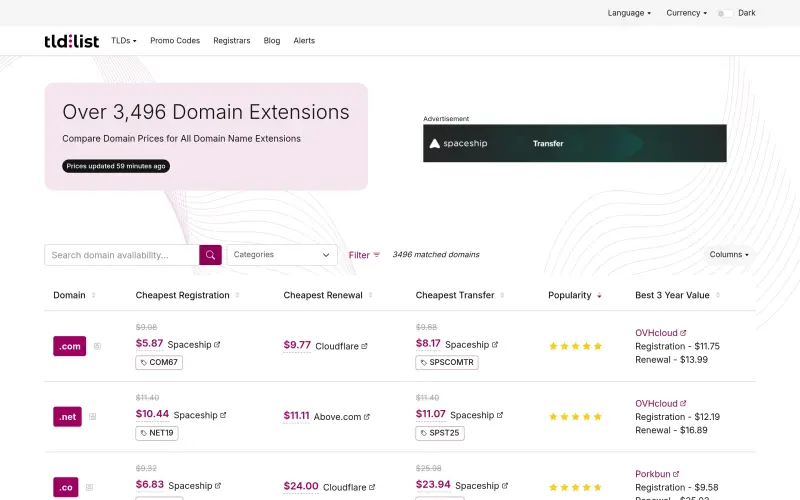
Compare 3,496 domain extensions. Registration, renewal, transfer — all in one table.
Overview
TLD-List is a free domain price comparison tool that tracks registration, renewal, and transfer costs across 3,496+ domain extensions and dozens of major registrars. It's designed for developers, founders, and domain investors who want to see real, structured pricing data, including long-term renewal costs, before choosing where to register a domain.
Instead of checking each registrar separately, TLD-List pulls publicly available pricing into a single sortable table, updated multiple times per week, with extra columns for availability, WHOIS privacy, DNSSEC support, and a 3-Year Value Score that accounts for the full cost of owning a domain over time, not just the first-year promo price.
Details
What are the key features of TLD-List?
• Cheapest registration, renewal, and transfer prices shown side-by-side across major registrars, updated multiple times per week from publicly available sources.
• 3-Year Value Score that factors in registration, renewal, and transfer costs together, so you can identify the best long-term deal rather than being drawn in by a low first-year price.
• Real-time domain availability checking, search a name to see which extensions are open to register right now, or include a specific TLD to check only that extension.
• Optional columns for WHOIS privacy availability, DNSSEC support, cheapest transfer price, and popularity, letting you filter by security and recognition, not just cost.
• A built-in Promo Codes section and Alerts feature so you can track deals and get notified about pricing changes for extensions you're watching.
Who is TLD-List best for?
• Founders and developers registering a domain for a new project who want to compare .com, .io, .app, and other extensions on actual three-year cost, not just sticker price.
• Domain investors who track pricing trends across gTLD and ccTLD spaces and need a reliable, regularly updated reference.
• Anyone managing multiple domains across different registrars who wants a single place to check transfer pricing and identify cheaper renewal options.
What are the top use cases for TLD-List?
• Catching the difference between a $0.98 first-year registration and a $10+ renewal before committing, the Cheapest Renewal column makes this visible at a glance.
• Searching a domain name to see availability across hundreds of extensions simultaneously, rather than running separate searches on each registrar's site.
• Comparing transfer costs when moving a domain away from an expensive registrar, using the optional Cheapest Transfer column.
How does TLD-List compare to alternatives?
• Compared to checking registrar websites directly: TLD-List aggregates data from publicly available registrar sources in one structured table, removing the need to manually open and compare multiple tabs.
• Compared to simpler TLD lookup tools: TLD-List adds the 3-Year Value Score, optional WHOIS privacy and DNSSEC columns, and a Popularity indicator, giving a more complete picture than tools that only show first-year registration prices.
What integrations and ecosystem support does TLD-List offer?
• Pricing data is pulled directly from publicly available registrar sources and APIs; no user account or API key is required to browse comparisons.
• Works entirely in the browser as a standalone web tool; no extensions, sign-ups, or software installs needed.
• Email alerts available for users who want to be notified of pricing changes or new features for specific TLDs.
What are the pros and limitations of TLD-List?
• Pros: Free with no account required; covers 3,496+ extensions with structured multi-column pricing data; the 3-Year Value Score helps avoid renewal price traps; real-time availability checking is built in.
• Limitations: Data comes from publicly available sources, so registrar-specific account discounts or unpublished promo pricing may not always be reflected; some registrars may not have complete or consistent pricing data available.
Built with
Keep researching TLD-List
Explore relevant products with a similar category, audience, or use case.

Submitted by

Hameem Mahmud
 ChatGPT,
 Claude,
 Perplexity,
 Gemini