

Web Speed
Unlock efficient web automation by translating complex websites into machine-readable formats for AI agents.
- Use Cases
- Not listed yet
- Pricing View
- Subscription
- Platforms
- Not listed yet
- Ideal For
- Developers SaaS Founders
Overview
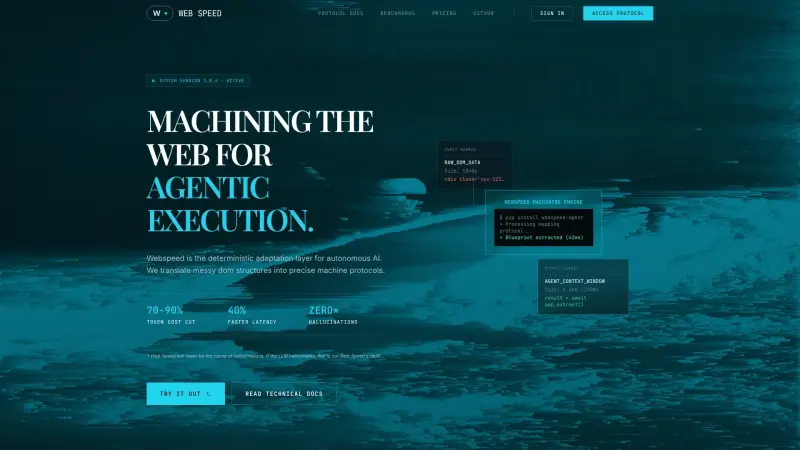
Web Speed is a logic layer for web agents, translating websites into high-fidelity machine maps for AI agents, helping developers integrate web data into their applications more efficiently.
It's designed to simplify the process of working with web data, making it easier for developers to focus on building their applications rather than struggling with web data integration.
Details
Key Features
- High-fidelity machine maps that accurately represent web data, reducing errors and improving application reliability.
- Token-efficient mapping, which minimizes the amount of data required to represent web pages, resulting in faster processing times.
- Support for translating any website into a machine-readable format, giving developers the flexibility to work with a wide range of web data sources.
- Improved application performance, as Web Speed's efficient mapping technology reduces the load on servers and improves response times.
Best For
- Developers building web scraping applications that require accurate and efficient web data integration.
- AI and machine learning teams working with web data, who need high-fidelity machine maps to train their models.
- Data scientists and analysts who need to extract insights from web data, and require a reliable and efficient way to integrate web data into their workflows.
Integrations
- Web Speed can be integrated with a wide range of applications and services, including AI and machine learning frameworks, data analytics tools, and web development frameworks.
Pros
- High-fidelity machine maps, token-efficient mapping, improved application performance, and enhanced developer productivity.
Limitations
- May require additional development effort to integrate with certain applications or services, and may not be suitable for very large-scale web data integration tasks.
Read full editorial notes
What are the key features of Web Speed?
High-fidelity machine maps that accurately represent web data, reducing errors and improving application reliability.
Token-efficient mapping, which minimizes the amount of data required to represent web pages, resulting in faster processing times.
Support for translating any website into a machine-readable format, giving developers the flexibility to work with a wide range of web data sources.
Improved application performance, as Web Speed's efficient mapping technology reduces the load on servers and improves response times.
Enhanced developer productivity, as Web Speed automates many of the tedious tasks associated with web data integration, freeing up developers to focus on higher-level tasks.
Who is Web Speed best for?
Developers building web scraping applications that require accurate and efficient web data integration.
AI and machine learning teams working with web data, who need high-fidelity machine maps to train their models.
Data scientists and analysts who need to extract insights from web data, and require a reliable and efficient way to integrate web data into their workflows.
What are the top use cases for Web Speed?
Building web scraping applications that require accurate and efficient web data extraction, such as monitoring website changes or extracting product information.
Training AI and machine learning models with high-fidelity web data, such as natural language processing or computer vision models.
Integrating web data into data analytics pipelines, such as data warehousing or business intelligence applications.
How does Web Speed compare to alternatives?
Unlike other web data integration tools, Web Speed focuses on delivering high-fidelity machine maps, resulting in more accurate, reliable web data integration.
Web Speed's token-efficient mapping technology also sets it apart from other tools, which often require more data to represent web pages, resulting in slower processing times.
What integrations and ecosystem support does Web Speed offer?
Web Speed can be integrated with a wide range of applications and services, including AI and machine learning frameworks, data analytics tools, and web development frameworks.
What are the pros and limitations of Web Speed?
Pros: High-fidelity machine maps, token-efficient mapping, improved application performance, and enhanced developer productivity.
Limitations: May require additional development effort to integrate with certain applications or services, and may not be suitable for very large-scale web data integration tasks.
Keep researching Web Speed
Explore relevant products with a similar category, audience, or use case.



Resources
Social Profiles
Useful Links
Launched
Ownership
If this is your product, contact us and we can help transfer it to you.
 ChatGPT,
 Claude,
 Perplexity,
 Gemini