
AI Agent Flow
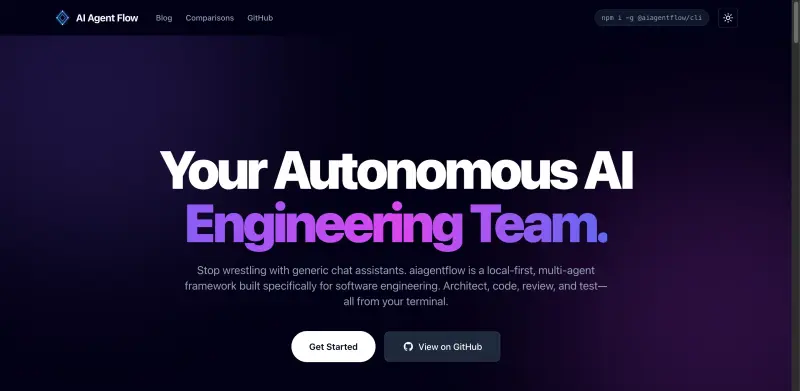
Streamline your development process with a local-first, multi-agent framework that codes, reviews, and tests for you.
- Use Cases
- Not listed yet
- Pricing
- Free
- Platforms
- Not listed yet
- Ideal For
- Not listed yet
Overview
Streamline Your Software Development with Autonomous AI Workflows
AI Agent Flow revolutionizes the way you develop software by automating tedious tasks, reducing manual errors, and increasing overall efficiency, allowing you to focus on high-level creative decisions and strategic planning.
Details
Key Features
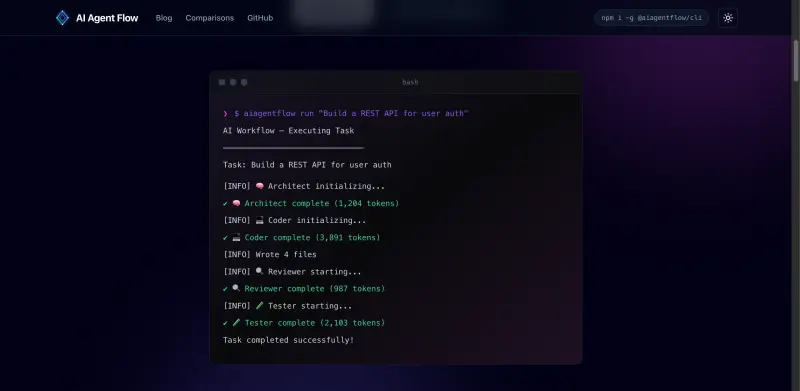
- Automated workflows that save 10+ hours weekly by orchestrating multi-agent AI workflows for software development, including architecting, coding, reviewing, and testing.
- Local-first approach ensures your code stays on your machine, eliminating cloud lock-in, data leaks, and context exhaustion, while providing reliable outputs and self-healing capabilities.
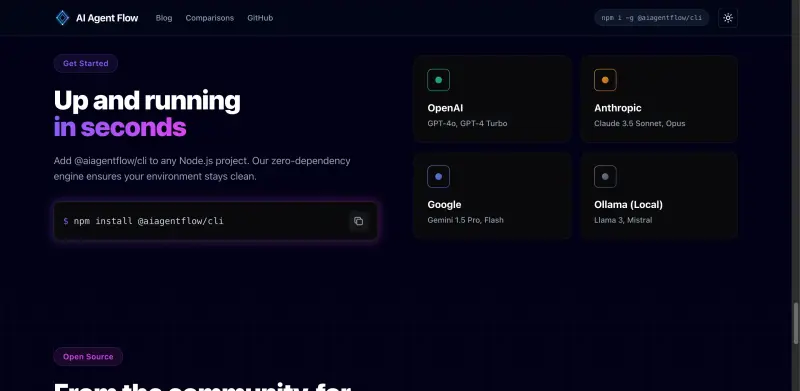
- Compatibility with top AI models, including Anthropic, OpenAI, Google Gemini, and Ollama, allowing you to leverage the best technologies for your specific needs.
- Extensive customization options through custom agents, prompts, and integrations, enabling you to tailor the workflow to your team's specific coding standards and requirements.
Best For
- Founders and CTOs of startups looking to accelerate their software development lifecycle without sacrificing quality or control.
- DevOps teams seeking to automate repetitive tasks, reduce manual errors, and improve collaboration across different stages of the development pipeline.
- Independent developers and small teams aiming to boost productivity, efficiency, and code quality while minimizing overhead and maintaining flexibility.
Top Use Cases
- Automating the development of responsive web applications, such as building a Next.js header, by leveraging AI agents to write clean, maintainable code and perform automated reviews and testing.
- Streamlining the creation of complex software architectures, such as microservices or cloud-native applications, by utilizing AI agents to analyze, plan, and implement robust, scalable designs.
- Improving code quality and reducing technical debt by using AI agents to perform automated code reviews, detect security vulnerabilities, and enforce coding standards across the entire codebase.
Integrations
- Integrates seamlessly with popular development frameworks, such as React, Vue, Node, and Python, and supports top AI models, including Anthropic, OpenAI, Google Gemini, and Ollama.
Pros
- High degree of automation, local-first approach, compatibility with top AI models, extensive customization options, and real-time streaming capabilities.
Limitations
- May require initial setup and configuration, and the quality of the output depends on the quality of the input and the specific AI models used.
Read full editorial notes
Key Features
- Automated workflows that save 10+ hours weekly by orchestrating multi-agent AI workflows for software development, including architecting, coding, reviewing, and testing.
- Local-first approach ensures your code stays on your machine, eliminating cloud lock-in, data leaks, and context exhaustion, while providing reliable outputs and self-healing capabilities.
- Compatibility with top AI models, including Anthropic, OpenAI, Google Gemini, and Ollama, allowing you to leverage the best technologies for your specific needs.
- Extensive customization options through custom agents, prompts, and integrations, enabling you to tailor the workflow to your team's specific coding standards and requirements.
- Real-time streaming and auto-detection capabilities, enabling you to monitor agent activity and automatically detect available models, streamlining your development process.
Ideal For
- Founders and CTOs of startups looking to accelerate their software development lifecycle without sacrificing quality or control.
- DevOps teams seeking to automate repetitive tasks, reduce manual errors, and improve collaboration across different stages of the development pipeline.
- Independent developers and small teams aiming to boost productivity, efficiency, and code quality while minimizing overhead and maintaining flexibility.
Top Use Cases
- Automating the development of responsive web applications, such as building a Next.js header, by leveraging AI agents to write clean, maintainable code and perform automated reviews and testing.
- Streamlining the creation of complex software architectures, such as microservices or cloud-native applications, by utilizing AI agents to analyze, plan, and implement robust, scalable designs.
- Improving code quality and reducing technical debt by using AI agents to perform automated code reviews, detect security vulnerabilities, and enforce coding standards across the entire codebase.
Known Alternatives
- A more comprehensive and flexible alternative to generic chat assistants, providing a deterministic multi-agent pipeline specifically designed for software engineering tasks and workflows.
- A lightweight, open-source solution compared to proprietary, cloud-based platforms, offering greater control, customization, and cost-effectiveness for development teams.
Integrations & Ecosystem
- Integrates seamlessly with popular development frameworks, such as React, Vue, Node, and Python, and supports top AI models, including Anthropic, OpenAI, Google Gemini, and Ollama.
Pros & Cons
- Pros: High degree of automation, local-first approach, compatibility with top AI models, extensive customization options, and real-time streaming capabilities.
- Limitations: May require initial setup and configuration, and the quality of the output depends on the quality of the input and the specific AI models used.
Keep researching AI Agent Flow
Explore relevant products with a similar category, audience, or use case.



Resources
Useful Links
FAQ about AI Agent Flow
Concise answers based on the product's editorial information.
What is the primary benefit of using AI Agent Flow for software development?
AI Agent Flow automates tedious tasks, reduces manual errors, and increases overall efficiency, allowing developers to focus on high-level creative decisions and strategic planning.
Is AI Agent Flow compatible with my existing development workflow and tools?
Yes, AI Agent Flow is designed to be flexible and adaptable, supporting popular development frameworks and integrating with top AI models, making it easy to incorporate into your existing workflow.
Launched
Ownership
If this is your product, contact us and we can help transfer it to you.
 ChatGPT,
 Claude,
 Perplexity,
 Gemini