

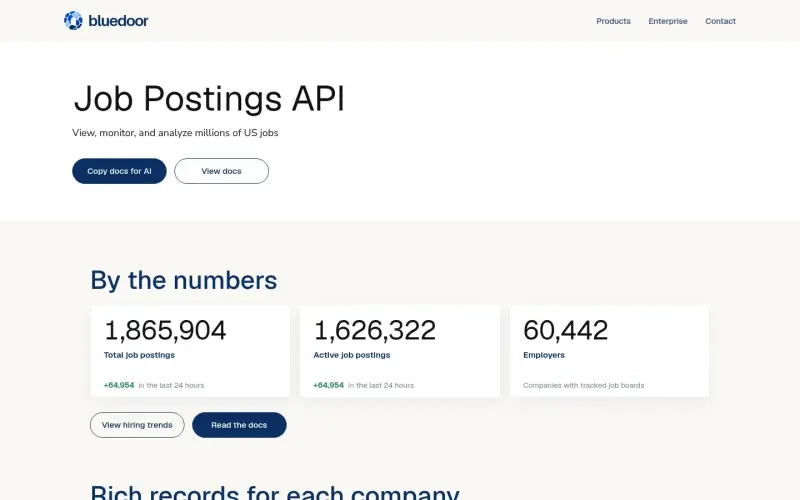

Job Postings API
Turn 1.8M+ US jobs into insights
130 website clicks
Launch week 24, 2026
- Use Cases
- Market Research Data Analysis
- Pricing
- Subscription
- Platforms
- Browser
- Ideal For
- Developers Enterprises
Overview
The Job Postings API provides programmatic access to view, monitor, and analyze millions of active US job postings across a vast spectrum of companies, locations, roles, and applicant tracking systems. It’s designed for data-driven professionals who need deep insights into the US labor market, enabling strategic decisions in talent acquisition, market intelligence, and competitive analysis.
By offering structured data on hiring trends, company-specific activity, and technological demands, this API moves beyond simple job listings to deliver a granular understanding of the employment landscape. It's built to integrate seamlessly into your analytical workflows, providing the timely information required for informed strategy.
Details
What is Job Postings API?
The Job Postings API offers a robust data feed that allows users to programmatically access, track, and analyze detailed information about active job openings across the United States. It's a foundational tool for anyone needing to understand the dynamics of the US hiring market, from individual company strategies to broad industry trends.
What are the key features of Job Postings API?
Access to over 1.6 million active US job postings from more than 60,000 employers, with new jobs added daily.
Rich, structured data records for each company, including all-time postings, new weekly openings, median compensation, salary ranges, and work models (on-site, hybrid, remote splits).
Detailed insights into hiring momentum, roles by function (e.g., Engineering, Research, Go-to-Market), top locations, and the specific technologies or SaaS tools required.
Comprehensive tracking across 39 major Applicant Tracking Systems (ATSs), such as Greenhouse, Lever, Workday, and Ashby, to identify employer preferences.
Capability to monitor job lifecycle events, including when roles are opened, updated, or closed, providing real-time market shifts.
Who is Job Postings API best for?
Market intelligence analysts and researchers who need granular data to identify economic trends, talent migration patterns, and competitive hiring practices.
Talent acquisition leaders and recruiting teams seeking to optimize their hiring strategies, understand compensation benchmarks, and identify in-demand skills.
SaaS companies, investors, and consultants tracking industry growth, technology adoption, and the health of specific market segments.
What can you use Job Postings API for?
Monitor and compare the hiring activities of specific companies, breaking down their open roles by department, city, and remote work policies.
Identify prevalent salary ranges and compensation trends for particular roles or locations, such as active software engineering roles paying above $200K in New York.
Analyze the adoption rates of specific technologies (e.g., Python, Kubernetes, React) or SaaS tools (e.g., Salesforce, Snowflake, GitHub) across job descriptions.
Track a company's job lifecycle events, from new postings to updates and closures, and determine which Applicant Tracking Systems they utilize.
How does Job Postings API compare to alternatives?
Unlike manual aggregation or basic scraping tools, the Job Postings API provides consistently updated, structured, and deep data for millions of US job postings, ready for immediate analysis.
Compared to general job market datasets, this API offers rich, company-specific records detailing hiring momentum, work models, functional role breakdowns, and explicit technology stacks, enabling more nuanced insights.
What integrations and ecosystem support does Job Postings API offer?
The API provides robust ecosystem support by tracking job postings across 39 major Applicant Tracking Systems, including Greenhouse, Lever, Workday, and many others, offering a broad view of employer practices. Direct integrations with other external analytical platforms are not clearly stated in the available source material.
What are the pros and limitations of Job Postings API?
Pros: Extensive and regularly updated coverage of millions of US job postings; Rich, granular data on company-specific hiring trends, compensation, and technology stacks; Comprehensive tracking of major Applicant Tracking Systems.
Limitations: The data provided focuses exclusively on US job postings, not international markets; Specific API rate limits or detailed pricing tiers are not clearly stated in the available source material.
Built with
Keep researching Job Postings API
Explore relevant products with a similar category, audience, or use case.


Launched
Ownership
If this is your product, contact us and we can help transfer it to you.
 ChatGPT,
 Claude,
 Perplexity,
 Gemini