

Lettertrace
Track your brand in AI assistant answers, free
- Use Cases
- Market Research Data Analysis
- Pricing
- Free
- Ideal For
- Developers Marketing Teams
Overview
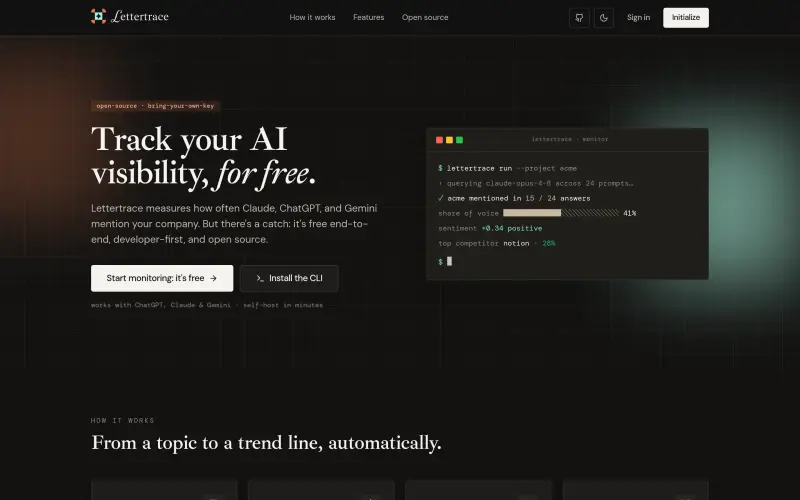
Lettertrace helps brand managers and marketing teams understand precisely how their company is represented in AI assistant answers from models like ChatGPT, Claude, and Gemini. It's an open-source, bring-your-own-key monitoring tool designed for those who need actionable insights into AI visibility, entirely free to use and inspect.
This tool allows users to track specific topics, automatically generate a variety of prompts to simulate real user queries, and observe trends over time. Its self-hostable nature means you retain full control over your data and API keys, providing a transparent and customizable approach to AI monitoring.
Details
Key Features
- Monitor Brand Mentions: Measures how often your company is mentioned by AI models like Claude, ChatGPT, and Gemini in response to specific topics.
- Automated Prompt Generation: Converts your core topics into dozens of natural-sounding prompt variations, simulating real user queries for comprehensive tracking.
- Performance Trend Analysis: Tracks brand visibility, prominence, and sentiment week over week, providing historical data to observe trends.
- Competitor Benchmarking: Compares your brand's share of voice, recommendations, and mentions against specified rival brands within AI answers.
Best For
- Marketing and Brand Teams: For understanding and managing brand perception within AI assistant answers.
- SEO and AEO/GEO Professionals: To track visibility, share of voice, and sentiment metrics relevant to AI search optimization.
- Developers and Tech-Savvy Users: Who prefer open-source tools, self-hosting, and full control over their data and infrastructure.
Top Use Cases
- Diagnosing AI Brand Mentions: Quickly identify and analyze how your brand is being discussed or recommended by AI assistants.
- Monitoring Key Topics: Track how your brand appears in responses to specific buyer questions or industry topics, such as "best CRM for startups."
- Understanding Competitive Landscape: Gain insights into your share of voice and compare your brand's prominence against competitors in AI-generated responses.
- Informing AI Strategy: Use data on visibility and sentiment to refine your content and communication strategies for AI platforms.
Integrations
- AI Model Integrations: Supports direct API connections with Anthropic, OpenAI, and Google for monitoring responses from Claude, ChatGPT, Gemini, and Google AI Overviews.
- Database Support: Stores your monitoring data in your own Supabase instance, providing full data ownership and preventing vendor lock-in.
Pros
- Free and Open-Source: The tool is freely available under an MIT license, allowing for full inspection, modification, and self-hosting without ongoing subscription costs
- Data Ownership and Control: Users bring their own AI API keys (encrypted at rest) and host their data in their own Supabase, ensuring privacy and preventing vendor lock-in
- Comprehensive AI Monitoring: Provides detailed metrics like visibility, share of voice, and sentiment across multiple AI models, generated from automatically varied prompts.
Limitations
- Requires Technical Setup: Users need to install the CLI and configure Supabase and API keys, which may require some technical comfort.
Read full editorial notes
What is Lettertrace?
Lettertrace is a monitoring tool that tracks how frequently and favorably your brand appears in responses from leading AI assistants. It helps marketing and brand teams measure their AI visibility, sentiment, and share of voice against competitors.
What are the key features of Lettertrace?
Monitor Brand Mentions: Measures how often your company is mentioned by AI models like Claude, ChatGPT, and Gemini in response to specific topics.
Automated Prompt Generation: Converts your core topics into dozens of natural-sounding prompt variations, simulating real user queries for comprehensive tracking.
Performance Trend Analysis: Tracks brand visibility, prominence, and sentiment week over week, providing historical data to observe trends.
Competitor Benchmarking: Compares your brand's share of voice, recommendations, and mentions against specified rival brands within AI answers.
Bring Your Own Key & Multi-Model Support: Uses your existing API keys for Anthropic, OpenAI, and Google, while supporting concurrent monitoring across various AI models.
Who is Lettertrace best for?
Marketing and Brand Teams: For understanding and managing brand perception within AI assistant answers.
SEO and AEO/GEO Professionals: To track visibility, share of voice, and sentiment metrics relevant to AI search optimization.
Developers and Tech-Savvy Users: Who prefer open-source tools, self-hosting, and full control over their data and infrastructure.
What can you use Lettertrace for?
Diagnosing AI Brand Mentions: Quickly identify and analyze how your brand is being discussed or recommended by AI assistants.
Monitoring Key Topics: Track how your brand appears in responses to specific buyer questions or industry topics, such as "best CRM for startups."
Understanding Competitive Landscape: Gain insights into your share of voice and compare your brand's prominence against competitors in AI-generated responses.
Informing AI Strategy: Use data on visibility and sentiment to refine your content and communication strategies for AI platforms.
How does Lettertrace compare to alternatives?
Compared to Manual Monitoring: Lettertrace automates the process of generating prompts, querying multiple AI models, and analyzing responses, eliminating tedious manual checks.
Compared to Proprietary Cloud Services: It offers a transparent, open-source, and self-hosted solution where users bring their own AI API keys, avoiding vendor lock-in, recurring usage markups, and keeping data within their own infrastructure (Supabase).
What integrations and ecosystem support does Lettertrace offer?
AI Model Integrations: Supports direct API connections with Anthropic, OpenAI, and Google for monitoring responses from Claude, ChatGPT, Gemini, and Google AI Overviews.
Database Support: Stores your monitoring data in your own Supabase instance, providing full data ownership and preventing vendor lock-in.
What are the pros and limitations of Lettertrace?
Pros: Free and Open-Source: The tool is freely available under an MIT license, allowing for full inspection, modification, and self-hosting without ongoing subscription costs; Data Ownership and Control: Users bring their own AI API keys (encrypted at rest) and host their data in their own Supabase, ensuring privacy and preventing vendor lock-in; Comprehensive AI Monitoring: Provides detailed metrics like visibility, share of voice, and sentiment across multiple AI models, generated from automatically varied prompts.
Limitations: Requires Technical Setup: Users need to install the CLI and configure Supabase and API keys, which may require some technical comfort.
Built with
Keep researching Lettertrace
Explore relevant products with a similar category, audience, or use case.



Resources
Useful Links
Launched
Ownership
If this is your product, contact us and we can help transfer it to you.
 ChatGPT,
 Claude,
 Perplexity,
 Gemini