
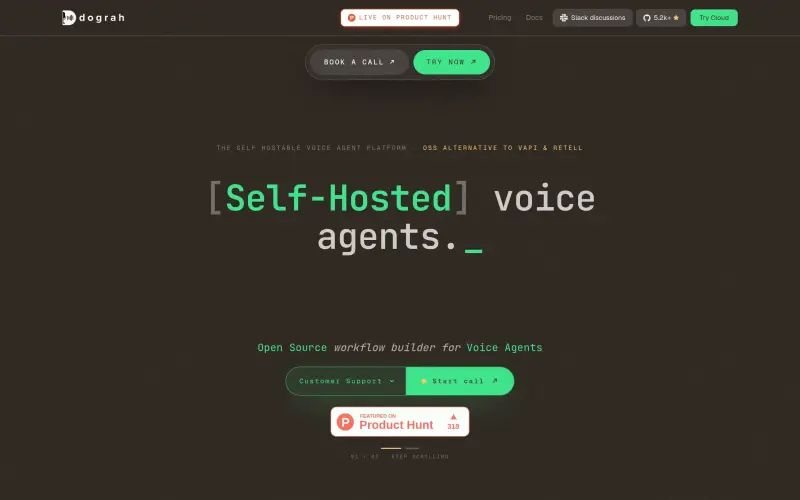

Dograh
Forkable open-source voice agents for complete infrastructure control
- Use Cases
- Customer Support Sales Outreach
- Pricing View
- Subscription
- Ideal For
- Developers Enterprises
Overview
Dograh is an open-source, self-hostable voice agent platform designed for engineering teams and enterprises that need full control over their AI communication infrastructure. It enables you to build and deploy custom voice agents on your own servers or in your private cloud, ensuring data privacy and compliance, particularly in regulated industries.
Unlike many cloud-based alternatives, Dograh allows you to bring your own AI models for speech-to-text, large language models, and text-to-speech, letting you fork and customize every aspect of the voice agent workflow for a truly unique and secure solution.
Details
Key Features
- **Complete Customization:** "Fork every box" to plug in your choice of inbound channels, STT, LLM, TTS, and telephony providers, or switch to a direct speech-to-speech pipeline.
- **Guaranteed Data Residency:** Deploy Dograh on-premises or within your own cloud VPC, ensuring that call data, recordings, transcripts, and model inferences never leave your boundary.
- **Compliance Ready:** Built with data security, residency, and compliance in mind, supporting standards like HIPAA, GDPR, SOC 2, ISO 27001, and CCPA, with no third-party vendor audit risk.
- **"Build by Writing" with MCP:** Leverage the Model Context Protocol (MCP) server to allow coding agents (e.g., Claude Code, OpenClaw, Cursor) to programmatically spin up, modify, and deploy voice agents within your development environment.
Best For
- Organizations in highly regulated industries that require strict data residency and compliance for voice communications.
- Engineering teams and developers seeking an open-source platform to build and deploy deeply customized AI voice agents.
- Businesses that prioritize owning their AI infrastructure, bringing their own models, and avoiding vendor lock-in for critical communication workflows.
Top Use Cases
- Developing and deploying custom AI calling agents, such as those for payment reminders or collections, with granular control over the workflow.
- Ensuring complete data sovereignty for voice agent interactions by running the entire stack on your own infrastructure or within your private cloud.
- Integrating a wide range of leading AI models and telephony providers into a unified, self-managed voice communication pipeline.
- Creating highly natural and engaging voice agent experiences that blend pre-recorded human speech with real-time text-to-speech for better call outcomes.
Integrations
- **Large Language Models (LLMs):** OpenAI, Gemini, Google, Groq, OpenRouter, Azure, AWS, Hugging Face, Minimax, Sarvam.
- **Speech-to-Text (STT):** Gladia, AssemblyAI, Speechmatics, Deepgram, OpenAI, Gemini, Google, Groq, OpenRouter, Azure, AWS, Hugging Face, Minimax, Sarvam.
- **Text-to-Speech (TTS):** ElevenLabs, Cartesia, Inworld, Camb.ai, Rime, Speaches, Smallest AI, AxAI.
- **Telephony Providers:** Plivo, Telnyx, Twilio, Vobiz, Vonage, Cloudonix, Asterisk.
Pros
- Open-source and self-hostable for maximum control
- ensures data residency and compliance
- highly customizable with bring-your-own-model support
- offers realistic human-like voice interactions.
Limitations
- May involve a learning curve for new users due to its deep customization and self-hosting requirements.
Read full editorial notes
What is Dograh?
Dograh is a self-hostable, open-source platform for building and managing AI voice agents, offered as an alternative to services like Vapi and Retell. It provides a flexible framework in which you can integrate your preferred AI models and deploy agents wherever you need them, while maintaining complete control over your stack.
What are the key features of Dograh?
**Complete Customization:** "Fork every box" to plug in your choice of inbound channels, STT, LLM, TTS, and telephony providers, or switch to a direct speech-to-speech pipeline.
**Guaranteed Data Residency:** Deploy Dograh on-premises or within your own cloud VPC, ensuring that call data, recordings, transcripts, and model inferences never leave your boundary.
**Compliance Ready:** Built with data security, residency, and compliance in mind, supporting standards like HIPAA, GDPR, SOC 2, ISO 27001, and CCPA, with no third-party vendor audit risk.
**"Build by Writing" with MCP:** Leverage the Model Context Protocol (MCP) server to allow coding agents (e.g., Claude Code, OpenClaw, Cursor) to programmatically spin up, modify, and deploy voice agents within your development environment.
**Human-Like Interactions:** Achieve up to 2x conversion rates and more natural conversations by blending pre-recorded human voice clips with live Text-to-Speech in the same cloned voice, reducing latency and cost.
**Real-Time Speech-to-Speech:** Utilize an audio-in/audio-out pipeline for ultra-low latency, fluid conversations, real turn-taking, and effective interruption handling across 70+ languages.
Who is Dograh best for?
Organizations in highly regulated industries that require strict data residency and compliance for voice communications.
Engineering teams and developers seeking an open-source platform to build and deploy deeply customized AI voice agents.
Businesses that prioritize owning their AI infrastructure, bringing their own models, and avoiding vendor lock-in for critical communication workflows.
What can you use Dograh for?
Developing and deploying custom AI calling agents, such as those for payment reminders or collections, with granular control over the workflow.
Ensuring complete data sovereignty for voice agent interactions by running the entire stack on your own infrastructure or within your private cloud.
Integrating a wide range of leading AI models and telephony providers into a unified, self-managed voice communication pipeline.
Creating highly natural and engaging voice agent experiences that blend pre-recorded human speech with real-time text-to-speech for better call outcomes.
How does Dograh compare to alternatives?
Dograh offers an open-source, self-hostable alternative to cloud-based voice agent platforms like Vapi and Retell, providing full control over code and infrastructure.
Unlike proprietary voice AI solutions, Dograh allows users to "fork every box" and integrate their preferred STT, LLM, and TTS models, eliminating vendor lock-in.
What integrations and ecosystem support does Dograh offer?
**Large Language Models (LLMs):** OpenAI, Gemini, Google, Groq, OpenRouter, Azure, AWS, Hugging Face, Minimax, Sarvam.
**Speech-to-Text (STT):** Gladia, AssemblyAI, Speechmatics, Deepgram, OpenAI, Gemini, Google, Groq, OpenRouter, Azure, AWS, Hugging Face, Minimax, Sarvam.
**Text-to-Speech (TTS):** ElevenLabs, Cartesia, Inworld, Camb.ai, Rime, Speaches, Smallest AI, AxAI.
**Telephony Providers:** Plivo, Telnyx, Twilio, Vobiz, Vonage, Cloudonix, Asterisk.
**Development & Monitoring Tools:** Langfuse and Tuner, along with support for Model Context Protocol (MCP) clients such as Claude Code, OpenClaw, Cursor, and Codex.
What are the pros and limitations of Dograh?
Pros: Open-source and self-hostable for maximum control; ensures data residency and compliance; highly customizable with bring-your-own-model support; offers realistic human-like voice interactions.
Limitations: May involve a learning curve for new users due to its deep customization and self-hosting requirements.
Keep researching Dograh
Explore relevant products with a similar category, audience, or use case.



Resources
Useful Links
Launched
Ownership
If this is your product, contact us and we can help transfer it to you.
 ChatGPT,
 Claude,
 Perplexity,
 Gemini