

OJCP
The open protocol for AI job discovery and application
- Use Cases
- API Integrations Agents
- Pricing
- Free
- Platforms
- Browser Chrome Extension
- Ideal For
- Developers SaaS Founders
Overview
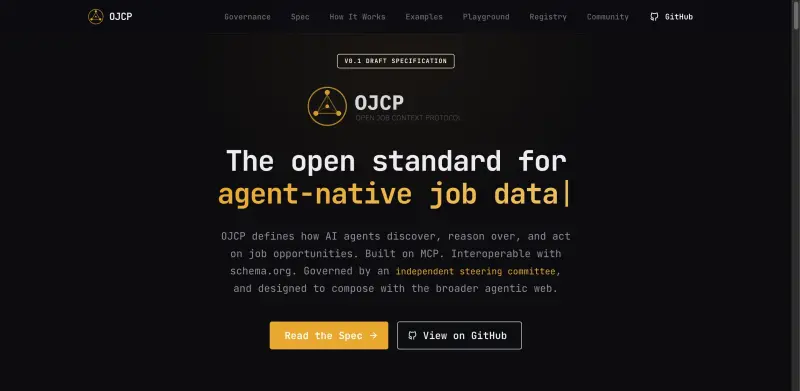
The Open Job Context Protocol (OJCP) provides an open standard for AI agents to discover, understand, and act on job opportunities. It helps job providers publish structured job feeds and enables agents to accurately evaluate and apply for roles on users' behalf, creating a more efficient and precise hiring ecosystem.
This shared protocol ensures that AI agents and job platforms speak the same language, facilitating automated discovery of job listings, personalized candidate matching without transmitting sensitive PII, and standardized application processes, all built on a privacy-respecting foundation.
Details
Key Features
- Provides an open standard for AI agents to interact with job feeds.
- Facilitates structured job discovery through provider manifests at a standard endpoint.
- Defines normalized application pathways, from ATS-direct to agent-ready flows.
- Prioritizes consent-first privacy for candidate data, using scoped information.
Best For
- Employers seeking to make their job listings fully consumable and actionable by AI agents.
- ATS vendors needing to integrate seamlessly with the broader agentic web and AI agent platforms.
- Job boards and staffing agencies aiming to standardize job data for automated discovery and processing.
- Developers of agent platforms building tools for job search, evaluation, and application.
Top Use Cases
- Allowing AI agents to automatically discover job provider capabilities, tools, and application paths.
- Enabling personalized job search results for candidates based on context, without direct PII sharing.
- Standardizing the initiation and tracking of job applications through AI agents.
- Structuring job context with schemas to support agent-based reasoning and action on opportunities.
Integrations
- Built on the Model Context Protocol (MCP), ensuring native compatibility with MCP tools and clients.
- Interoperable with schema.org, extending existing job posting definitions with agent-specific fields.
- Provides a documented API for building and trying out agent integrations and data feeds.
- The full specification is viewable on GitHub, promoting transparency and collaborative development.
Pros
- Establishes a common language for AI agents and job providers
- ensures privacy with consent-first, scoped data handling
- governed by an independent, diverse coalition
- offers structured discovery and normalized application paths.
Read full editorial notes
What is OJCP?
OJCP is an open standard designed to structure job feed data for consumption by AI agents. It enables agents to uniformly discover job opportunities, interpret their details, and initiate application processes.
What are the key features of OJCP?
Provides an open standard for AI agents to interact with job feeds.
Facilitates structured job discovery through provider manifests at a standard endpoint.
Defines normalized application pathways, from ATS-direct to agent-ready flows.
Prioritizes consent-first privacy for candidate data, using scoped information.
Enables agent-aware job ranking by supporting candidate context for personalized results.
Offers MCP-native tools for common job actions such as searching, retrieving details, and initiating applications.
Who is OJCP best for?
Employers seeking to make their job listings fully consumable and actionable by AI agents.
ATS vendors needing to integrate seamlessly with the broader agentic web and AI agent platforms.
Job boards and staffing agencies aiming to standardize job data for automated discovery and processing.
Developers of agent platforms building tools for job search, evaluation, and application.
What can you use OJCP for?
Allowing AI agents to automatically discover job provider capabilities, tools, and application paths.
Enabling personalized job search results for candidates based on context, without direct PII sharing.
Standardizing the initiation and tracking of job applications through AI agents.
Structuring job context with schemas to support agent-based reasoning and action on opportunities.
How does OJCP compare to alternatives?
Unlike proprietary job feed formats, OJCP offers an open, coalition-governed standard that ensures interoperability and helps prevent vendor lock-in for both job providers and agent developers.
Compared to traditional, less structured job data, OJCP provides a shared protocol and specific schemas that allow AI agents to consistently understand and act on job opportunities, streamlining automated workflows.
What integrations and ecosystem support does OJCP offer?
Built on the Model Context Protocol (MCP), ensuring native compatibility with MCP tools and clients.
Interoperable with schema.org, extending existing job posting definitions with agent-specific fields.
Provides a documented API for building and trying out agent integrations and data feeds.
The full specification is viewable on GitHub, promoting transparency and collaborative development.
Supports browser-native agents via WebMCP, allowing access to OJCP tools through `navigator.modelContext`.
What are the pros of OJCP?
Pros: Establishes a common language for AI agents and job providers; ensures privacy with consent-first, scoped data handling; governed by an independent, diverse coalition; offers structured discovery and normalized application paths.
Keep researching OJCP
Explore relevant products with a similar category, audience, or use case.



Resources
Useful Links
Launched
Ownership
If this is your product, contact us and we can help transfer it to you.
 ChatGPT,
 Claude,
 Perplexity,
 Gemini