

- Use Cases
- Workflow Automation Building AI Agents
- Pricing View
- Subscription
- Ideal For
- Developers DevOps Teams
Overview
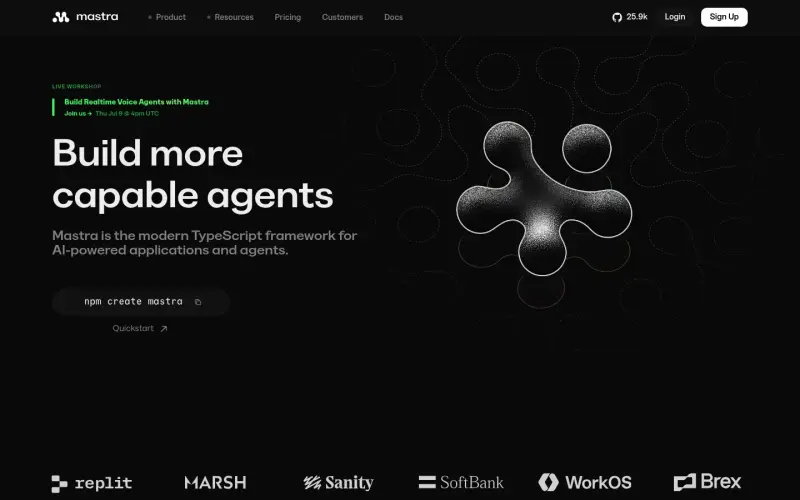
Mastra is a TypeScript framework that helps developers build AI-powered applications and agents, providing a comprehensive set of tools for memory, workflows, and observability to streamline development.
With Mastra, developers can create agents that reason, remember, and act, and easily integrate them into their existing workflows, whether it's for internal automation, customer-facing interactions, or developer platform agents, making it an ideal choice for teams looking to build more capable agents.
Details
Key Features
- Agents can be defined using specific instructions, models, and tools, enabling customized behavior and decision-making.
- Mastra provides built-in observability features that enable developers to monitor and understand agent behavior, including evals, metrics, datasets, and traces.
- Mastra supports various types of agents, including internal automation agents, customer-facing agents, and developer platform agents, making it a versatile framework for different use cases.
- Mastra integrates with frontend and backend frameworks such as React, Next.js, and Node.js, enabling seamless integration into existing workflows.
Best For
- Development teams building AI-powered applications and agents, looking for a comprehensive framework to streamline their workflow.
- Organizations with complex workflows, seeking to automate and optimize their processes using AI-powered agents.
- Startups and enterprises looking to build customized AI solutions, leveraging Mastra's flexibility and scalability.
Top Use Cases
- Building internal automation agents to streamline workflows and improve productivity.
- Creating customer-facing agents to provide personalized support and improve customer experience.
- Developing developer platform agents to provide shared agent primitives and build customized AI solutions.
Integrations
- Mastra integrates with frontend and backend frameworks such as React, Next.js, and Node, and supports deployment as a standalone server, providing flexibility in ecosystem support.
Pros
- comprehensive set of features for agent development, deployment, and management
- built-in observability features
- support for various types of agents
- flexibility in terms of ecosystem support.
Limitations
- limited information available on pricing and support options
- may require significant development expertise to fully leverage its features.
Read full editorial notes
What is Mastra?
Mastra is an open-source framework that enables developers to build AI-powered applications and agents using TypeScript, providing a robust set of features for agent development, deployment, and management. It allows developers to define typed agents with instructions, models, tools, and runtime behavior in one place, making it easy to create and manage complex agent workflows.
What are the key features of Mastra?
Agents can be defined using specific instructions, models, and tools, enabling customized behavior and decision-making.
Mastra provides built-in observability features that enable developers to monitor and understand agent behavior, including evals, metrics, datasets, and traces.
Mastra supports various types of agents, including internal automation agents, customer-facing agents, and developer platform agents, making it a versatile framework for different use cases.
Mastra integrates with frontend and backend frameworks such as React, Next.js, and Node.js, enabling seamless integration into existing workflows.
Mastra provides a robust set of tools for agent development, deployment, and management, including workflows, memory, and harness, making it easy to build and deploy agents.
Who is Mastra best for?
Development teams building AI-powered applications and agents, looking for a comprehensive framework to streamline their workflow.
Organizations with complex workflows, seeking to automate and optimize their processes using AI-powered agents.
Startups and enterprises looking to build customized AI solutions, leveraging Mastra's flexibility and scalability.
What can you use Mastra for?
Building internal automation agents to streamline workflows and improve productivity.
Creating customer-facing agents to provide personalized support and improve customer experience.
Developing developer platform agents to provide shared agent primitives and build customized AI solutions.
How does Mastra compare to alternatives?
Mastra offers a more comprehensive set of features for agent development, deployment, and management compared to other TypeScript frameworks, making it a more robust choice for complex AI-powered applications.
Mastra's built-in observability features and support for various types of agents make it a more versatile framework compared to other AI development platforms.
What integrations and ecosystem support does Mastra offer?
Mastra integrates with frontend and backend frameworks such as React, Next.js, and Node, and supports deployment as a standalone server, providing flexibility in ecosystem support.
What are the pros and limitations of Mastra?
Pros: comprehensive set of features for agent development, deployment, and management; built-in observability features; support for various types of agents; flexibility in terms of ecosystem support.
Limitations: limited information available on pricing and support options; may require significant development expertise to fully leverage its features.
Keep researching Mastra
Explore relevant products with a similar category, audience, or use case.



Resources
Social Profiles
Useful Links
Launched
Ownership
If this is your product, contact us and we can help transfer it to you.
 ChatGPT,
 Claude,
 Perplexity,
 Gemini