

Prelint
Review product specs in every pull request
- Use Cases
- Automated Testing
- Pricing View
- Subscription
- Platforms
- Browser
- Ideal For
- DevOps Teams Enterprises
Overview
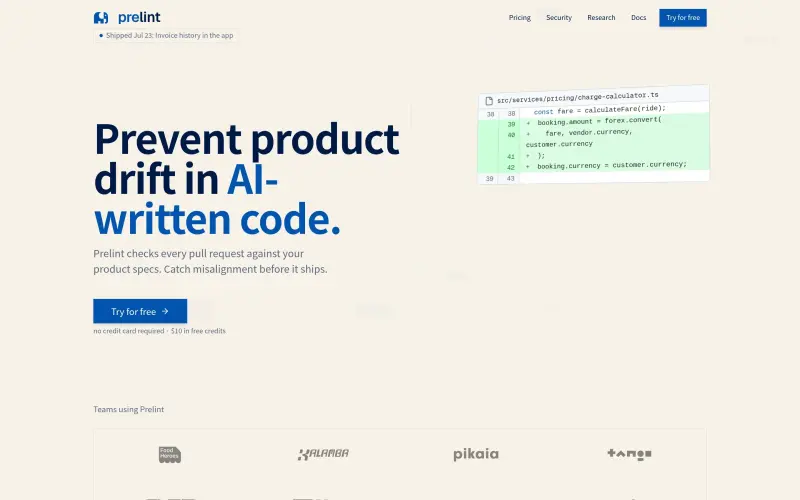
Prelint is a tool that helps teams catch product drift, inconsistencies, and misalignment in their code before it ships, by reviewing product specifications on every pull request. This is particularly useful for teams using AI-generated code, where small mistakes can add up quickly.
Prelint integrates into a team's existing workflow, checking every pull request against the product specs to ensure consistency, completeness, and alignment with existing decisions. This automated review process helps prevent product drift, which can occur when AI-generated code introduces changes that aren't aligned with the product's intent or specs.
Details
Key Features
- Automated product review on every pull request, checking for consistency, completeness, and alignment with existing decisions
- Machine-readable product constraints, allowing Prelint to understand the full product context and catch contradictions between specs
- Integration with GitHub, making it easy to incorporate into a team's existing workflow
- Product intent enforced automatically, ensuring that the code aligns with the product's specs and intent
Best For
- Teams using AI-generated code, where small mistakes can add up quickly, and automated review is crucial
- Developers who want to ensure that their code aligns with the product's specs and intent
- Product managers who want to prevent product drift and ensure that the code aligns with the product's vision
Top Use Cases
- Preventing product drift and ensuring that the code aligns with the product's specs and intent
- Catching inconsistencies and misalignment in the code before it ships
- Automating product review on every pull request, reducing the need for manual review, and saving time
Integrations
- Prelint integrates with GitHub, making it easy to incorporate into a team's existing workflow
Pros
- automated product review
- machine-readable product constraints
- integration with GitHub
- zero retention and no training on your data
Limitations
- may require additional setup and configuration to integrate with a team's existing workflow
Read full editorial notes
What is Prelint?
Prelint is a tool that reviews product specifications on every pull request, helping teams catch misalignment and inconsistencies before they ship. It integrates with GitHub, checking every pull request against the product specs to ensure consistency and alignment with existing decisions.
What are the key features of Prelint?
Automated product review on every pull request, checking for consistency, completeness, and alignment with existing decisions
Machine-readable product constraints, allowing Prelint to understand the full product context and catch contradictions between specs
Integration with GitHub, making it easy to incorporate into a team's existing workflow
Product intent enforced automatically, ensuring that the code aligns with the product's specs and intent
Zero retention and no training on your data, ensuring that your code and specs remain private and secure
Who is Prelint best for?
Teams using AI-generated code, where small mistakes can add up quickly, and automated review is crucial
Developers who want to ensure that their code aligns with the product's specs and intent
Product managers who want to prevent product drift and ensure that the code aligns with the product's vision
What can you use Prelint for?
Preventing product drift and ensuring that the code aligns with the product's specs and intent
Catching inconsistencies and misalignment in the code before it ships
Automating product review on every pull request, reducing the need for manual review, and saving time
How does Prelint compare to alternatives?
Prelint is more focused on product review and preventing product drift, whereas other tools may focus more on code review or automated testing
Prelint's automated review process is more comprehensive, checking for consistency, completeness, and alignment with existing decisions
What integrations and ecosystem support does Prelint offer?
Prelint integrates with GitHub, making it easy to incorporate into a team's existing workflow
What are the pros and limitations of Prelint?
Pros: automated product review; machine-readable product constraints; integration with GitHub; zero retention and no training on your data
Limitations: may require additional setup and configuration to integrate with a team's existing workflow
Keep researching Prelint
Explore relevant products with a similar category, audience, or use case.



Resources
Social Profiles
Launched
Ownership
If this is your product, contact us and we can help transfer it to you.
 ChatGPT,
 Claude,
 Perplexity,
 Gemini